Entries
Entity — Imprisoned Mythic Being The Sphinx A living mythic entity imprisoned in the form of a wooden desk. The reception desk of Reynold's Limited Curiosities, downtown Blythe. Entity — Cosmic Observer / Psychopomp The Palindrome An eternal being from beyond the rift. Intelligence operative, guardian, and guide to the threshold. "One half of it anyway." Entity — Demiurge / Creator God / Cosmic Parasite The Infant Heart The creator of the material universe. The Wireland cosmology's version of the Gnostic Demiurge, rewritten with a pathos the original mythology rarely afforded its false god. Historical Event — Ritual / Inflection Point September 11, 2001 A ritual. A mass-scale working of black magic capitalism that redirected the trajectory of human civilization. The moment the mechanisms of control achieved their most complete expression on American soil. Dynasty — The Poisonous Flower / Pharmaceutical Branch The Sackler Family The family that industrialized American addiction. A petal of the poisonous flower — the pharmaceutical arm of black magic capitalism, turning pain into product and grief into a subscription model.
The Sphinx — Wireland Lorebook Illustration
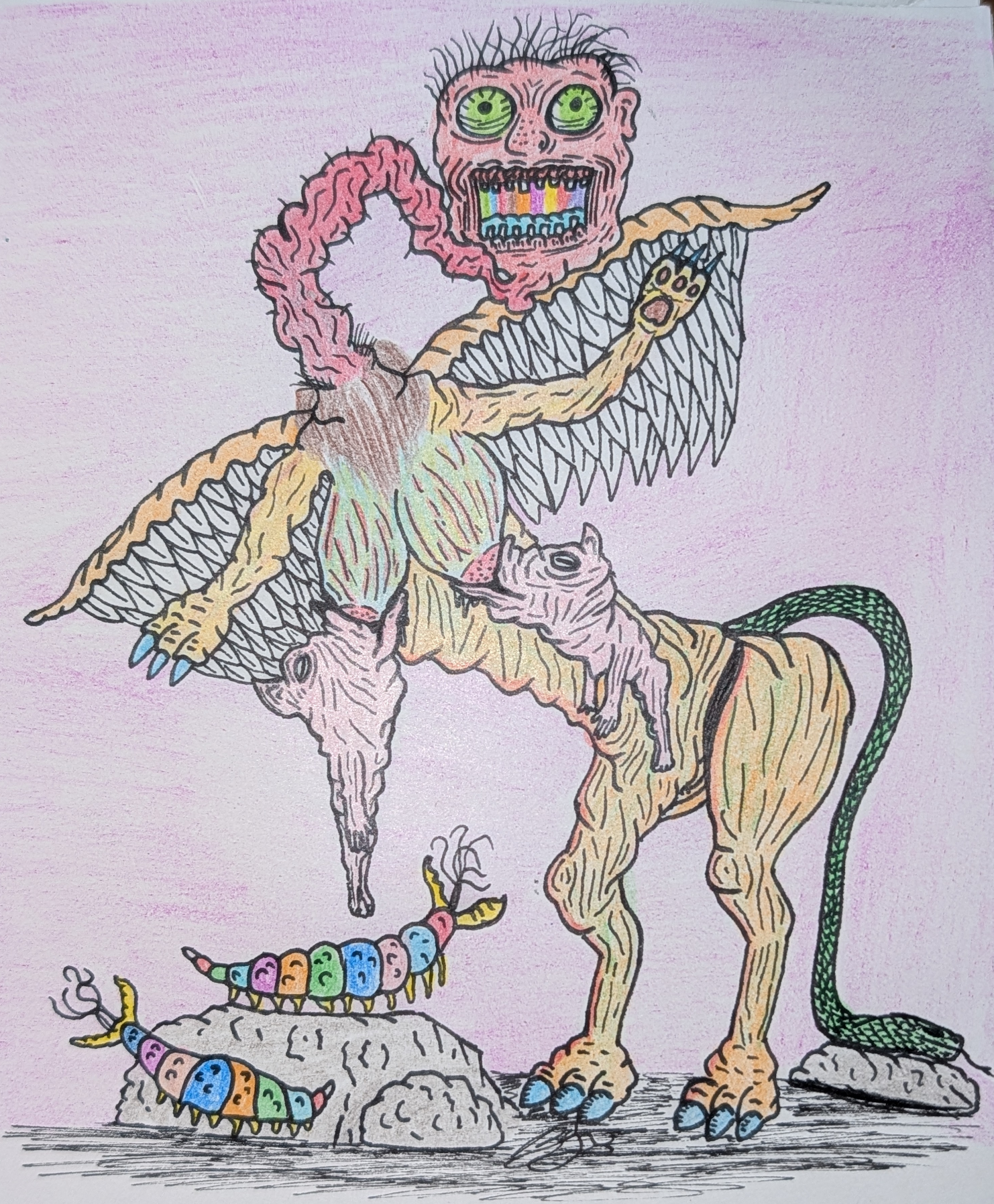
The Sphinx — Illustrated for the Wireland Lorebook — Art by Bradley Findly @cozicannibal
The Sphinx
Imprisoned Mythic Being / Living Prison
Designation "the majestic Sphinx," "the war-torn sphinx," "the mythical desk monster"
Gender Female
Status Killed by the Infant Heart (Ep. 12, Pt. 2)
Location Reynold's Limited Curiosities, downtown Blythe — serves as the reception desk
First Appearance Episode 1 — "Return of the Overseer"
Final Appearance Episode 12, Pt. 2 — "The Word Virus"
Series Wireland Ranch

Dormant State (Wood Form)

The Sphinx is carved from ornate wood with a finish described as "grey snakes swimming on the surface of void black oil," polished to a mirror-like reflective sheen. The jaundiced fluorescent light of the shop appears purified and transformed when reflected from the desk surface, mirrored back "dingy and cold." The craftsmanship is seamless — Our Driver cannot identify joins or toolmarks.

Serpent Tail

A placid serpent suspended between two kneeling lion legs. Described as "impotent" — it hangs limp and passive in the dormant state. The serpent's mouth is the exit point for the Wyrms after they subdue the Sphinx in Ep. 1, stretched afterward "like an old sock." By Episode 11, the serpent drags along the floor with a "pallid and still" tongue, suggesting progressive deterioration.

Lion Legs / Paws

Kneeling, paws settled into divots on the laminate floor. Gaunt stomach stuck to the ribs, bones showing through matted and bloody fur.

Human Torso

The chest curves upward but dips down in a submissive pose. Human breasts hang downward, nipples wrapped by the lips of the suckling Pig Infants (see: Infant Heart). Front arms bent outward behind the creatures, awkwardly cradling them, palms outstretched and supporting the weight of the slab top.

Human Head

Face buried in what appears to be a bowl of dog food, "splashes of wood carved slop frozen in the hair and dripping off the ears." After the Wyrm attack in Ep. 1, the head lifts — and from this point forward, the face is frozen in a menacing snarl, eyes locked on Our Driver.

Eagle Wings

Splayed above the entire figure, low and straight over the back of the head, ending in sharp knife-like feathers past the impotent tail. The wings serve as the structural base for the slab top of the desk. Critically, the wings remain black and immobile even when the rest of the creature animates — they are the bonds that prevent her from breaking completely free.

Animated State (Awakened)

When the Sphinx comes to life, the wood-grain illusion shatters. Color erupts — but wrong. In place of natural golden-brown, the lion legs flush bright lime. Blood appears as deep purple, "the color of a fresh bruise." Highlighter-bright neon colors swirl over the entire body except the wings, which remain black and fixed — the physical mechanism of her imprisonment.

Her teeth are pink. Her saliva is thick and white, flung outward when she gnashes at threats. The bone beneath is stark white, splitting through the gray grain. There is a phosphorescent quality to her fluids — her purple blood glows, seeping from old wounds.

Deterioration

By Episode 11, the Sphinx's condition has worsened considerably. She stumbles forward "drunkenly," spots of glowing phosphorescent purple blood seeping from old wounds. The serpent tail drags along the floor rather than holding any posture. She is malnourished, ragged, a creature whose body is failing but whose will and power remain formidable.

"The growl emanating from her does not indicate weakness despite the rag of a body it emanates from within."

Episode 11 — Wireland Ranch

By Episode 12, bones are visible through gaps in her flesh. She is ultimately strangled by her own serpentine tail at the hands of the Infant Heart's piglet avatars.

The Sphinx is a living mythic entity — not a carving that comes to life, but a living creature imprisoned in the form of a wooden desk. The Everywhere Voice's warning establishes this: she has been "known to seek attention when she is in heat." The narrator muses on the paradox of wood being in heat, but the joke underscores that this is a biological being, not an enchanted object.

She is explicitly categorized as a myth: a being whose nature exists outside and in tension with "reality" as the Wireland cosmology defines it.

"That's the thing about myths, no sense of reality."

The Everywhere Voice — Episode 1

The Sphinx as a Cell

The most revealing line comes from the Infant Heart in Episode 12, Pt. 2, after the piglets kill the Sphinx:

"Consider that a gesture of goodwill, Driver. It was time to strip ourselves of that cell anyway."

The Infant Heart — Episode 12, Pt. 2

The Sphinx's body was a prison cell — specifically, a cell for the Infant Heart. The pig-headed infants that suckle the Sphinx's breasts in the dormant carving are avatar-forms of the Infant Heart entity, and the Sphinx is the structure that contained them.

"We have killed our cage. And we will kill this one as well."

The Infant Heart — Episode 12, Pt. 2

This recontextualizes everything: the Sphinx is a containment vessel built to imprison a fragment or aspect of the Infant Heart. Her aggression toward Our Driver may not be predatory hunger but the rage of a prisoner, or the defensive instinct of a warden whose captive is being activated.

Who Is Imprisoned Inside Her

Episode 7 directly teases this mystery when the Narrator lists potential story threads: "Maybe I should tell you all exactly who is imprisoned inside of our war-torn sphinx?" This is presented as an unanswered question — one of many threads the Narrator defers, placing it alongside the history of the Palindromes and the origins of Agent Orange's indoctrination.

Episode 11 reinforces this framing: the Palindrome's replay of the Ep. 1 scene describes the Sphinx as "a neon sphinx gnashing at him out of fear and anger, a prisoner unable to break the bonds that hold it in limbo." This explicitly frames the Sphinx not as a monster-guardian but as a captive — someone or something trapped within the desk-form, raging against bonds they cannot break.

The Infant Heart / Pig Infants

The three pig-headed infants are physically attached to the Sphinx in her dormant form — suckling at her breasts. They are manifestations of the Infant Heart entity, the cosmological force that Abria and the old gods have shattered and distributed across multiple prisons (what the Infant Heart bitterly calls a "GODHEAD SCAVENGER HUNT"). The relationship is parasitic and adversarial. In Ep. 1, the Sphinx's first act upon awakening is to claw and destroy the infants. They reform in Ep. 12 from the same black fluid, climb back onto her body, and use her own serpentine tail to strangle her to death. After killing her, they hold a brief vigil — each kneeling and kissing the lion's head before pushing her body into the foundational substrate. Imprisonment, yes, but also something resembling respect or grief at the end.

The Everywhere Voice

The Everywhere Voice acts as a kind of warden or handler. She warns Our Driver about the Sphinx, insults her freely, threatens her with punishment, and ultimately unleashes the Wyrms when the Sphinx cannot control herself. The dynamic reads as a corrections officer managing an inmate — the Voice knows the Sphinx's nature, her triggers, and the exact countermeasure to control her.

The Wyrms

The technicolor Wyrms serve as the Sphinx's control mechanism. They live within the fluorescent light fixtures of Reynold's Curiosities. When deployed, they are segmented, rainbow-glowing, with mouths at both ends containing jagged spinning teeth. They bore into the Sphinx's flesh and cause her to cry in agony before forcing her back into wooden stillness. After subduing her, the Wyrms exit through the serpent tail, combine into a spiral of white light, and form into the luminous Protector figure. They are not independent agents — they are components of a larger entity.

The Protector / Apparition

After the Wyrms merge, they form a humanoid figure with dreadlocked hair that splits into separate colors forming orbiting discs. This being speaks with a different voice than the Everywhere Voice and is described as having "set the ragged sphinx back into its place." The Palindrome later references "his protector" in the same context, confirming this figure serves a guardian function in relation to the shop and the Overseer's journey.

Our Driver / The Overseer (Joseph)

The Sphinx's fixation on Our Driver is consistent and intense across every appearance. Her eyes lock on his. She lunges, gnashes, claws toward him. And yet Episode 11 describes the emotional quality of her growl as "a potent mix of fear and anguish and something else, something akin to hate, but only when love also happens to be at play." There is something personal and emotionally complex in the Sphinx's relationship to the Overseer — not pure predatory instinct.

Abria

Abria orchestrated the imprisonment of the Infant Heart fragments, and the Sphinx appears to be one of those containment vessels. Abria's line — "One more word out of you and you will long for the days you suckled milk from a sphinx" — spoken to the Infant Heart, confirms the nursing relationship was real and known to the cosmic hierarchy.
Episode 1 — "Return of the Overseer"
First encounter. Dormant desk form → animation → attacks Driver → Wyrms deployed → subdued → returns to wooden stillness with face now snarled toward Driver. Pig infants destroyed by her claws, seep into floor.
Episode 3.5
Referenced indirectly. The Narrator mentions "that vicious terrible animal that was forced into my mind." Party scene with three nightmarish entities celebrating nearby while Abria promises the Overseer she will "melt them down."
Episode 4
The acacia wood box (the delivery from Reynold's) shares the same wood stain and stylistic description as the Sphinx desk — gray grain through sable void, "starless and bible black." This links the Sphinx's material composition to the larger rune-carved, orchid-engraved relics of the Wireland cosmology.
Episode 7
The Narrator explicitly teases: "Maybe I should tell you all exactly who is imprisoned inside of our war-torn sphinx?" Listed among the great unanswered mysteries.
Episode 9
The Sphinx of Old Kingdom Egypt is referenced in the Narrator's monologue about time — noting it was already considered "ancient and arcane" a mere thousand years later in the New Kingdom. Grounds the mythological resonance: the concept of the Sphinx as something that predates even ancient civilizations' ability to understand it.
Episode 11
Joseph returns to Reynold's Curiosities via the Palindrome's guided replay. He re-witnesses the Ep. 1 scene as observer. Later, alone in the shop, the Sphinx awakens again — stumbling, bleeding, malnourished, but still powerful. She approaches him. He begs for one more moment. The episode ends on her attack.
Episode 12, Pt. 2 — "The Word Virus"
The pig infants reform from the black fluid, climb the Sphinx, and use her own serpent tail to strangle her. They hold a vigil, kiss her head, and push the body into the dissolving floor. The Infant Heart declares the Sphinx was their "cell" and its destruction a gesture of goodwill toward the Driver.
Source Episodes: 1, 3.5, 4, 7, 9, 11, 12 (Pts. 1 & 2) • Series: Wireland Ranch • Compiled from all available scripts in the Wireland canon.
The Palindrome — Illustrated for the Wireland Lorebook
The Palindrome
Cosmic Observer / Psychopomp / Messenger Species
Designation "Palin," "Drome," "the haze," "forever snack"
Gender / Sexuality Asexual — "We are asexual. I'd hate to let you down."
Status Dissipated — End of Episode 11 (no confirmed death)
Plurality Singular entity and species — "one half of it anyway"
First Appearance Episode 6 — "Psychic Driving" (reporting to Chicanery)
Major Appearances Episodes 6, 7, 8, 11
Series Wireland Ranch

The Problem of Perception

The Palindrome's true form cannot be perceived by human consciousness. What Joseph sees is explicitly described as "a translation, a soft whisper from the other side of the rift." The entity acknowledges this directly: "I am not how you perceive me to be." When the time comes for Joseph to perceive the Palindrome's actual nature, "you will know naught else" — suggesting the full truth of its being would overwhelm and replace all other knowledge.

Perceived Form: The Contorted Haze

What Joseph's mind renders when it encounters the Palindrome is a mass of contorted angles that bend back on themselves, breaking, shifting, and reforming with each calculated movement. The description is deliberately paradoxical — geometry that folds in on itself, a shape that is never the same shape twice.

Chaotic Shifting Patterns

The angles slide in and out of perception, as if the entity exists partially outside the range of human sensory capability.

Impossible Color Spectrum

Reflects colors "from a spectrum nothing that lives has ever seen" — light that registers on no known biological receptor.

Environmental Absorption

Takes in particles of matter from surrounding walls and blends them into itself, then pushes them back out — but permanently altered. Each atom that passes through the Palindrome "leaves something of itself behind, something that can never again be retrieved." The Palindrome doesn't just exist in space; it changes space by existing in it.

Haze Form

At distance or in reduced interaction, the Palindrome appears as "a mere haze floating along." It "sways" in place and retreats to this hazier presentation when giving Joseph space, obscuring itself in dark corners.

Warmth and Tactility

Despite its alien appearance, physical contact with the Palindrome produces warmth — "the warmth radiating through his arm, pulsing waves through his body." It can take Joseph's hand, and the touch feels real and comforting even when Joseph's own body "seems to be gone."

Behavioral Presentation

The Palindrome initially hides in darkness when first appearing to Joseph in Episode 11, retreating to "the darkest corner of the room, obscuring itself from our Overseer, giving him the space to adjust, to acclimate and accept, hoping he would come to the necessary conclusions alone." This suggests a deliberate care for Joseph's psychological wellbeing — a strategy of patience rather than force.

It moves "slowly into the soft glow" only after Joseph has had time to process, revealing itself gradually rather than imposing its presence.

What the Palindrome Is

The Palindrome belongs to a species or class of beings that exist beyond the rift — the boundary between observable reality and whatever lies outside it. They are categorized among entities the Narrator (the Archaeologist) describes as "my kind," beings who do not die and who possess knowledge that would destroy human consciousness if fully disclosed.

"I am eternal and therefore I can be eaten forever."

The Palindrome — Episode 6

This is not metaphor — the Palindrome explicitly confirms it does not die in any conventional sense. The Archaeologist's opening monologue in Episode 11 draws the distinction: "you, my dear dear friends, will ultimately return to the void. But I will not."

Pre-Temporal

Exists from before time and space. The Archaeologist's cosmological framing — "a time before time, and a space before space" — includes the Palindrome's kind in the category of beings that predate the observable universe.

Plural / Dual

Introduces itself as "one half of it anyway, so you can call me Palin, or Drome, it's all the same to me." This palindromic self-structure (the name reads the same in both directions) suggests a fundamental duality — a being that mirrors itself, that is the same read forward or backward.

Observer from Beyond the Rift

The Palindrome exists on "the other side of the rift" — its perceived form is a "translation" across this boundary, a compression of something incomprehensible into a shape that won't immediately destroy human cognition. This places it fundamentally apart from the petty gods, who emerged from within the created universe.

The Palindrome's "Kind"

The Palindrome is part of a broader taxonomy of non-human entities in the Wireland cosmology. The Narrator's Episode 11 monologue refers to "those of my kind" who deem humanity's potential discovery of reality's observational nature as "the one sin." This places the Palindrome in the same cosmic tier as the Archaeologist — entities who exist outside the cycle of human death and rebirth, who hold knowledge about the fundamental structure of reality.

However, the Palindrome occupies a very specific niche within this hierarchy. It operates as a subordinate who reports to Chicanery (and by extension the petty gods), yet simultaneously acts as Joseph's protector and guide against those same powers. This dual allegiance — or perhaps double agency — is central to understanding what the Palindrome actually is.

The Species Rule

"Us Palindromes have a rule. Never turn your back on the ghosts of human energy. Especially the trickiest among them."

The Palindrome — Episode 6

This is the only confirmed rule of the Palindrome species. It establishes that Palindromes are plural — a species or class, not a unique entity. They maintain vigilance around concentrations of human psychic residue, particularly the most dangerous manifestations like Chicanery. And the rule implies vulnerability — you don't make a rule about not turning your back unless turning your back has consequences.

The Palindromic Principle

The entity's name is itself significant. A palindrome reads the same forward and backward — it is symmetrical across time, identical whether you approach it from the beginning or the end. In a cosmology obsessed with cycles ("time is a flat circle," "everything that has happened will happen again"), a being that is the same in both temporal directions embodies the fundamental structure of existence as the Wireland mythology presents it.

The self-description as "one half" deepens this: the Palindrome is incomplete alone, requiring its mirror-half to be whole. Whether this other half is another entity, a temporal reflection, or something else entirely is not established in the scripts.

Intelligence Operative

In Episode 6, the Palindrome operates as a field agent delivering a report to Chicanery on "Project Agent Orange." It provides detailed intelligence on Agent Orange's interception by the Sherpa, his processing at Ravensclaw, and the psychic driving procedure. The Palindrome is sarcastic, meta-aware (it describes flashbacks as "a narrative device"), and openly uncomfortable in Chicanery's presence — it follows the rule of never turning its back.

The Palindrome knows that Chicanery already possesses all the information being reported — making the report a ritual of hierarchy rather than genuine intelligence sharing. This positions the Palindrome as a being compelled to serve a master it does not respect.

Protector of the Overseer

Across Episodes 7, 8, and 11, the Palindrome functions as Joseph's guardian and guide through the psychic wilderness. In Episode 7, it calls Joseph to the base of the tower during his flight across the diseased pink landscape, guiding him toward safety while the parasitic entity pursues. Later, when the gold mist creature seizes him, the Palindrome intervenes directly — "Take our hand" — followed by a screeching crash and silence.

In Episode 8, Malfastice identifies the Palindrome as the primary obstacle to their plans. Malfastice's frustration that Joseph "was supposed to be alone. To be isolated. To be unfuckingloved" frames the Palindrome's companionship itself as the act of resistance — love, or something functionally equivalent to it, disrupting the isolation protocol.

Psychopomp / Guide to the Threshold

The Palindrome's most significant function is shepherding Joseph to the point of irreversible choice. In Episode 11, it leads him through several stages: rescue from the parasitic assault, orientation in the tower room (a liminal space with walls made of compressed galaxies), the cosmic "zoom out" through space and time, the replay of Episode 1 as observer rather than participant, the revelation of Godwynn's ritual, and finally — the door.

"This is the last chance. We can return back to the confines of your mind and you can let that thing chase you for the next 50 years, though to you, it will seem far longer. Damn close to forever. Or you can walk through the door. Once you do, the decision is made. There is no going back, not for you, not for anyone else."

The Palindrome — Episode 11

The Palindrome tells Joseph he is "in the unfortunate situation, for reasons beyond even our awareness, to break a cycle that has been spinning for millennia." Even the Palindrome doesn't know why Joseph specifically is the one positioned to break the cycle. It can guide him to the threshold, present the choice, and protect him from the forces trying to prevent him from reaching it — but the mechanism of selection is beyond even the Palindrome's understanding.

Farewell and Dissipation

When Joseph agrees to go through the door, the Palindrome immediately treats the verbal agreement as binding — "That is agreement" — and departs with a final whispered incantation: "All * the * moments * are * gone." Each word punctuated by a snap. Then: [SOUND OF PALINDROME DISSIPATING].

The Palindrome does not walk through the door with Joseph. Its function ends at the threshold. It guides to the boundary but does not cross.

Irreverent Intelligence

The Palindrome is consistently characterized by sharp wit, meta-awareness, and dark humor. It talks back to cosmic entities, corrects their language ("Cajun sounds racist"), describes narrative devices by their technical names, and maintains a tone of cheerful detachment even in dangerous situations.

Meta-Narrative Awareness

Knows it is in a story. Describes flashbacks as narrative devices. Calls watching Godwynn's arrival "our favorite part." Uses "LOL" in dialogue. References laugh tracks as structural elements.

Sardonic Irreverence

"Slow your roll there big guy. You're gonna hurt yourself again" (to Malfastice, a cosmic entity of immense destructive power). "You guys sure are proud of some pretty weird shit" (to Chicanery and Malfastice, regarding the Holocaust).

Genuine Care Masked by Humor

Despite the constant jokes, the Palindrome's actions toward Joseph are consistently protective and patient. It hides in corners to give him space. It speaks gently when needed: "It's okay Joseph." It offers warmth through physical contact.

Plurality in Speech

Almost always uses "we/our/us" — "Take our hand," "We cannot hold it forever," "We can show you how," "our favorite part." This is not a royal "we" — it reflects the Palindrome's dual/plural nature as "one half" of a complete entity, or possibly speaks for the Palindrome species collectively.

Relationship with Truth

The Palindrome is notably honest about the limits of what it can share. It will not reveal the full nature of the parasitic entity without caveats. It acknowledges that Joseph's situation involves factors "beyond even our awareness." It tells Joseph the truth about what the choice will cost — "you will never see the fruits of that labor" — without sugar-coating or manipulation. When it says there will be "immense hardship and pain," it also notes that inaction carries the same cost — an honest assessment of equally terrible options.

This contrasts sharply with virtually every other supernatural entity in the Wireland cosmology, most of whom traffic in deception, manipulation, or partial truths deployed strategically. The Palindrome is the sole exception — it tells Joseph what it can, acknowledges what it cannot, and does not pretend the choice it presents is anything other than terrible in both directions.

Chicanery

The Palindrome reports to Chicanery as a subordinate, but the dynamic is adversarial rather than loyal. Chicanery threatens to eat the Palindrome (met with the cheerful response about being an eternal snack). The Palindrome follows its species rule of never turning its back on Chicanery — treating the petty god as a dangerous concentration of "human energy" that requires constant vigilance. After completing its report, Chicanery asks: "Why are you still standing here?" and the Palindrome cites the rule directly. The implication is that Chicanery's orders concluded, and the Palindrome's rule is the only thing keeping it in place — watching, not serving. What happens "behind that wall" after the report is left deliberately vague: "let's just say eternal is being put to the test."

Malfastice

Malfastice views the Palindrome as a direct threat to the petty gods' plans. "He is fighting back, he is fighting back with that fucking palindrome" establishes the Palindrome as Joseph's weapon against cosmic manipulation. Malfastice's frustration that Joseph "was supposed to be alone" and "unfuckingloved" frames the Palindrome's companionship itself as the act of resistance — love, or something functionally equivalent to it, disrupting the isolation protocol. The Palindrome responds to Malfastice's fury with dry humor — "Slow your roll there big guy" — suggesting either genuine fearlessness or a calculated performance of it.

Joseph / Our Driver / The Overseer

The Palindrome's relationship with Joseph is the emotional core of the entity's arc. Across all appearances, it functions as protector (intervening against the parasitic voice, the gold mist entity, and the broader assault on Joseph's psyche), guide (leading him through cosmic space, replaying events for understanding, presenting the final choice), companion (Malfastice's complaint confirms this — the Palindrome's presence prevents Joseph's total isolation, which is the petty gods' primary strategy), and honest broker (unlike the Everywhere Voice, the Sherpa, or the petty gods themselves, the Palindrome speaks plainly about costs, limits, and uncertainties). The farewell — "All * the * moments * are * gone" — is final and irrevocable. The Palindrome does not promise to return. It dissipates.

The Parasitic Entity / Voice in His Head (VIH)

The Palindrome directly opposes the parasitic entity that inhabits Joseph's psyche. In Episode 11, the entity attacks from below the tower room while the Palindrome tries to keep Joseph focused and safe above. The Palindrome acknowledges it "cannot hold it forever" — establishing that even an eternal being has limits against this particular threat. When Joseph asks what the entity is, the Palindrome struggles: "It's ummmm, rather hard to explain." The dynamic positions the Palindrome and the parasite as opposing forces fighting over Joseph's consciousness — one trying to free him, the other trying to consume him.

The Archaeologist / Narrator

Both are eternal. Both belong to a category of beings predating the universe. Both demonstrate meta-narrative awareness and dark humor. The Narrator teases the Palindromes' history as a discrete subject in Episode 7, suggesting they are distinct from whatever the Narrator is — but the parallels are striking. Whether they are the same kind of entity or different species with overlapping traits is not established.

Episode 6 — "Psychic Driving"
Intelligence operative. Reports to Chicanery on Project Agent Orange; delivers detailed account of the Sherpa's interception and psychic driving procedure at Ravensclaw. Sarcastic, meta-aware, openly uncomfortable. Follows the species rule of never turning its back. Subjected to something "behind that wall" afterward.
Episode 7
Disembodied guide. Voice calling Joseph through the diseased pink landscape; guides him to the base of the tower while the parasitic entity pursues. Intervenes when the gold mist creature seizes him — "Take our hand" — followed by a screeching crash and silence. Referenced by the Narrator as having an "unabridged history" that could be told but is deferred.
Episode 8
Named threat to petty gods. Identified by Malfastice as the entity enabling Joseph's resistance. Present in the scene between Chicanery, Malfastice, and the Palindrome where Chicanery tells the story of Goebbels and propaganda. The Palindrome provides running commentary and moral judgment. Cheerfully responds "Hiiiii!" when discussed as a cosmic adversary.
Episode 11
Central figure / psychopomp. Rescues Joseph from the parasite; shelters him in the tower room; takes him on the cosmic "zoom out" journey at the speed of light; replays Episode 1 events as observer; reveals Godwynn's ritual and the corporate sacrifice; presents the door — the final, irreversible choice. Departs with the incantation "All * the * moments * are * gone." Dissipates.
Source Episodes: 6, 7, 8, 11 • Series: Wireland Ranch • Compiled from all available scripts in the Wireland canon.
The Infant Heart — Illustrated for the Wireland Lorebook
The Infant Heart
Demiurge / Creator God / Cosmic Parasite
Designation "the heart," "the parasite," "the symbiote," "Father," "our idiot infant heart," "the voice in his head" / VIH, "the thing beneath," "the pulse," "the beat"
Gender / Sexuality Uses we/our/us pronouns; gendered male by Abria ("Father," "he/him"); functionally beyond gender
Status Diminished, fragmented, ultimately consumed — Joseph's suicide allows Godwynn to take the parasite from his body; Abria ascends as the Heart's power wanes
Plurality Manifests as three pig-headed infants (physical avatars), a single golden parasitic organism (implanted form), and a disembodied voice (psychological manifestation). Uses plural pronouns: "we," "us," "our"
First Appearance Episode 1 — "Return of the Overseer" (as the pig-headed infant sculptures suckling the Sphinx Warden)
Major Appearances Episodes 1, 2, 4, 5, 7, 11, 12

The Demiurge

The Infant Heart is the creator of the material universe — the Wireland cosmology's version of the Gnostic Demiurge, though rewritten with a pathos the original mythology rarely afforded its false god. According to Abria's account in Episode 12, before anything recognizable as matter, space, or time existed, there was only the pleroma — the divine fullness, a perfect void enveloping all that has neither beginning nor end.

The Infant Heart was born from this perfection as a mistake: an abortion of the divine, created through the corruption of the feminine spirit that forms one half of the opposing forces underlying all existence. It was, in Abria's words, a "vile perversion of perfection."

Despite this origin, the Infant Heart was loved and cared for by its mother. In what Abria considers the first and only irredeemable act, her brethren destroyed the father and debated the infant's fate. In secret, the mother hid a spark away — placed it in the creature's belly as a farewell gift: a child she would never again hold.

Cast out, forgotten, voiceless for eternity, moldering in the mists, tearing at itself, grasping at the minutest glimpse of the transcendent divide. Weak and alone, it could not even remember what to call its own.

The Failed Creation

What the Wireland describes as the Big Bang was the Infant Heart's first act of personhood — the first moment it experienced personal, conscious experience. But flawed and lacking, the image it made was flawed: "petulant finger paints slapped against the walls of the nursery" — leaving a parent who had long since abandoned him to all possible states of being at once, drowning in its own inadequacy.

For billions of years, swirling in a "stupid snake knot" around itself, it did not have the talent to define reality, only the echoes of stolen consciousness. Suddenly alone.

Cosmological Critique

The critical theology: the design that emerged did not carry any love or intention. Humanity, and by extension all evolved life, exists but was never comprehended. The Infant Heart's indictment is total: humans are inherently flawed because their creator is flawed. "Treason. People keep inventing new methods of feudalism, attack each other, believe they are entitled to rule others" — because their maker is "a shadow of a sickness." Control, jealousy, greed, these energies are divine in origin. The gods (Chicanery, Malfeasance, Nilgiri, Lilith) are cyclical iterations of the Infant Heart's operating system, running on hardwired cruelty.

"Order is a disease."

The Infant Heart

The Infant Heart manifests in at least three distinct physical forms across the series, each representing a different aspect of its nature.

The Pig-Headed Infants

The most visible and offensive physical form. Named "piglets" by Episode 1, seen first inside Reynold's Limited Curiosities. Three small, grotesque, pig-headed baby creatures with clear skin through which deflating and puddling organs are visible, laminated between cracked white tile and dissolving into fluid that bubbles back up through the seams, melting and congealing.

Baby-like in their joint movements, communicating in some private language while being simultaneously terrifying. They stumble on tiny feet, oinking, filthy, helpless, and giggling. They hesitantly climb by the serpentine tail, laughing together. After holding a vigil on their knees, each kneels to kiss the lion's head of the fallen Sphinx, pooling together. One salutes the Driver with a tiny hoof.

The piglets hum "Taps" among themselves, assemble into a totem pole, and walk toward the Driver. They communicate in something that is the best approximation of speech, "pitched to something at your brain's lowest, most removed, blob-like, shifting register."

The Golden Parasite / Implanted Form (VIH)

An internal, parasitic organism — referred to as the Voice in His Head (VIH). A visceral, tortured hood of gold, post-heart surgery. Ripped open to reveal itself to you, telling you the truth. Brutal, alien, and now metaphysically present inside the world the Overseer inhabits.

The Disembodied Voice

By Episode 7, the Infant Heart speaks as a relentless engine of self-destruction and purposeful sadism. Its words are hooks — it looks upon the Overseer's particular relationship, sees his skin and peels it back until it hurts, until he begs for it to stop.

"How do you feel right now? Been sittin' in that chair for days. Or weeks. Do you even know what day it is anymore? Do you? Or has something else taken control of the vessel?"

The Infant Heart — Episode 7

Its vocabulary is cruel and psychologically forensic, weaponizing memories, insecurities, family, and every failed partnership.

The Mistress / Miniature Heart Organ

A flaxen-haired harpist in bandages, drilling cuffs of gold. Exists below the Palindrome's room, demanding a cortisone injection into the vein, screaming: "the adrenaline thumps in me."

"SUCH A WARM AND WELCOMING FAMILY UNIT WE WILL MAKE."

The Infant Heart (ritual)

The Infant Heart eventually becomes something more plainly terrifying: a voice soon to arrive. Officially becoming the Voice in His Head, as the parasite reaches the pineal gland.

Narratively confirmed as the road Joseph always walks — his demiurge doesn't just maintain its grip on the material world, it deliberately puts "the Overseer" (a cosmic title) through orchestrated, millennial-scale, consciousness-while-you-continue-to-exist cycles.

The Fifty-Year Sequence

Reality itself is equipment: the Drive, the mind, the body, the ceaselessly replaced consciousness — all serving one end. When enough of the Infant Heart's pieces are assembled, when the host is overwhelmed, when the pieces snap into place and the fractures clear, there is a moment of weakening where the Overseer is vulnerable. The collapse is not a wound. It is warm, unconditional, a whisper softly spoken:

"Hello Lea."

The Infant Heart

The Infant Heart doesn't simply inhabit the Overseer — it engineered the entire cycle. The Overseer exists as a recurring vessel, a cosmically appointed host through which the Heart's fragmented power can reassemble. Each iteration of the Overseer's life follows the same pattern: awakening, discovery, psychological deterioration, and ultimately surrender.

The mechanism is both parasitic and architectural. The Heart needs the Overseer not just as a body but as a conscious, suffering mind — the emotional energy of the host's breakdown appears to be the catalyst that allows the Heart's fragments to coalesce. Trauma is fuel. The Overseer's personal failures, relationships, and self-destruction are not incidental to the cosmic narrative — they are the cosmic narrative.

The Infant Heart is characterized by its impossible combination of significance and insignificance. It is the creator of everything, and it is a tantrum-throwing, self-pitying, insult-hurling child. It is both of these things simultaneously.

Core Traits

Defiance

"So fucked I am. So far gone. So far gone I don't even blink anymore. That's why I rap my knuckles against your skull."

Mockery

"Cavemen built girds. You've built Glee. Your plan got cancelled early."

Glee at Others' Pain

"I KNEW IT! I told you earlier. You'd lose your composure. OHHH YOU ARE LOSING HIM. I TOLD YOU THAT YOU WOULD FAIL!"

Victimhood

"We didn't ask for this." / "We didn't choose it."

Submission Disguised as Defiance

"Yes, bitch."

The Godhead Scavenger Hunt

The Infant Heart's fragments were scattered deliberately — what it bitterly calls a "GODHEAD SCAVENGER HUNT." Abria and her agents dismantled the Heart's unified form and distributed its pieces across multiple prisons (the Sphinx being one such cell). The VIH form represents the Heart's most dangerous fragment: the one lodged inside the Overseer's consciousness, with direct access to his mind and emotions.

Abria (Queen of the Lotophagi / Pentagonal Mother)

Antagonist. Includes what appears to be genuine disgust: "a nasty, vile, disgusting mess. YOUR MESS THAT I HAVE TO CORRECT." Movements against her are futile but compulsive. As well as something resembling respect or long-frozen responsibility: "Don't play tricks with the democrats."

Our Driver (Joseph / The Overseer)

Host. Listener. Victim. Reluctant participant. The Infant Heart treats the Overseer with an impossible clarity of goals — "MY PURPOSE IS TO MAKE A POINT" — while simultaneously menacing: "Hello, you. Look at me. What did you just say? Come closer. Come closer. Good night now. We'll talk in the morning, hey. What did you say?"

The Sphinx

Former prison. The pig-headed infants suckle from the Sphinx — a parasitic relationship disguised as nurturing. Upon breaking free, they strangle her with her own serpent tail, hold a vigil of ambiguous grief, and push her body into the foundation. "Consider that a gesture of goodwill, Driver. It was time to strip ourselves of that cell anyway."

The Palindrome

Unclear but antagonistic. The Palindrome serves as guardian and guide to the Overseer, which positions it in direct opposition to the Heart's parasitic agenda. The Heart's response to the Palindrome is notably muted — suggesting mutual recognition, or perhaps fear.

The Pig Infants

Extensions of itself. The piglets are not offspring but autonomous avatars — fragments of the Heart given independent physical form. Their silken, milk-drunk communion with each other represents the Heart's rare moments of internal harmony, a scattered god briefly at peace with its own pieces.

Nathaniel Godwynn

Unfazed, autonomous, problematic. Godwynn is a celebrated doughnut magnate, an eccentric billionaire, corporate raider born in 1895, CEO of kingdoms and steward of infrastructure — and also heir to the Heart's corpse. Immortal.

Evil as Origin

The Infant Heart is not the devil. Its evil is not defiance or bravado or rebellion — it is the absence of anything better. It is a god that created a universe not out of malice but out of incapacity. The Wireland's core theological question: is evil more or less devastating when it has no alternative? Is a universe designed by an incompetent, abandoned child worse than one designed by a malicious architect? The answer is left ambiguous: "Who is worse? The one who manufactured the source of all evil, or the one who IS the source?"

The Fabrication Question

Is the Infant Heart's evil genuine, or is it the performance of an angry child? Its power is real. Its cruelty is real. But its emotional register — though, is that of a toddler who missed a nap. The question of whether the universe's fundamental cruelty is cosmically ordained or the tantrum of a neglected infant is the Wireland's most uncomfortable metaphor.

The Landlord Coincidence

The Infant Heart functions as a dark mirror of life itself — a coincidence of fundamental energies diminished and replenished, energies round and round, "sweeping across the ground." The same meaningless cycle, the same hollow center, the same absence of inherent value that produces and enforces everything we experience.

Episode 1 — Pig-Headed Sculptures
First physical appearance as three pig-headed infant sculptures suckling the Sphinx desk. The Sphinx claws and destroys them upon awakening — a connection to the Overseer's hallmark wound.
Episode 2 — The Mouth / Youth
Puppet state. Pink fleshed. Emerges via wound.
Episode 4 — Unnamed / Felt
Presence sensed. Fear established. The creature's role begins to crystallize.
Episode 5 — The Parasite
Named. Implanted. Confirmed as internal entity.
Episode 7 — The Voice
Full psychological attack. The VIH as an engine of targeted cruelty.
Episode 11 — The Architect
Cosmological reveal. The Infant Heart as creator god. Context for the entire institutional mainframe.
Episode 12 — The Infant Heart
Full manifestation. Origin story. Kills the Sphinx. Confronts the Overseer. Its tragedy is that it understands its own inadequacy across billions of years — and still has enough of the divine spark to feel it.

The Infant Heart is the Wireland's central metaphor for the question: what made us this way? If we are broken, who held the job? If we are cruel, who drew the blueprint? Why is the architect an infant? Why is an institution's default cruelty? And more uncomfortably: if the "big creator" turns out to be an infant, what happens to the trauma of existence — both literally and politically — when there is no adult in the room?

"Cast out. Forgotten. Voiceless for eternity, moldering in the mists, tearing at itself, grasping at the minutest glimpse of the transcendent divide."

Abria — on the Infant Heart's exile

"NOW * LET * ME * IN."

The Infant Heart

"I AM NECESSARY."

The Infant Heart

"THERE IS NOTHING YOU CAN DO TO CHANGE THIS."

The Infant Heart

"Don't think of this as a prison. Think of it as a very, very large room."

Abria — to the Infant Heart
The Sphinx / Sphinx Warden Desk

Prison cell for the Heart's pig-headed avatars. Destroyed in Episode 12.

Reynold's Limited Curiosities

Location of the Sphinx. The shop where the Overseer first encounters the physical avatars.

Wireland Ranch

Primary setting. The property where the Overseer's cycle plays out.

The Palindrome's Room

Contains access to the Mistress form (implied).

The Overseer's Chair

The seat where the VIH attacks are received. A figment, a shooting star, a silent edge, a drill.

A stuttered, affected delivery pattern. Binaural at 19Hz. Variably pitched, layered, uncanny noise vibration and enunciation. The voice is designed to feel simultaneously intimate and alien — something speaking from inside the listener's own skull.

Source Episodes: 1, 2, 4, 5, 7, 11, 12 (Pts. 1 & 2) • Series: Wireland Ranch • Compiled from all available scripts in the Wireland canon.
September 11, 2001 — Illustrated for the Wireland Lorebook
September 11, 2001
Historical Event / Ritual / Inflection Point
Designation "a ritual for the ages," "a wound on the face of the planet," "the blossoming of a great poisonous flower," "a spell"
Classification Mass-scale working of black magic capitalism
Status Irreversible — "No correction, only a sharp turn to the ground"
Primary Source Episode 3.5 — "Never Forget (lol)" [dedicated interstitial]
Secondary Sources Episode 8, TDS Episode 11, Kayfabe Nation, Wireland Now: The Dark Enlightenment, Thanksgiving Prayer Interstitial
Series Wireland Ranch, The Dope Show, Wireland Now

September 11, 2001 is framed within the Wireland cosmology not as a singular political or military event but as a ritual — a mass-scale working of black magic capitalism that redirected the trajectory of human civilization. It is described explicitly as a spell, a wound, and an inflection point from which no correction is possible, only a sharper descent.

The narrator (Voidbro669) treats 9/11 as the single most consequential act of modern sorcery, the moment when the mechanisms of control perfected by Bernays and Goebbels achieved their most complete expression on American soil. In the Wireland framework, the event sits at the apex of a throughline that begins with the Torches of Freedom campaign (Ep 8), runs through Nazi propaganda and the weaponization of irrational forces (Ep 8), the Bush family's Nazi-adjacent financial origins (Ep 3.5), the stolen 2000 election (Ep 3.5), and extends forward into the Patriot Act, the War on Terror, the surveillance state, Palantir, and ultimately the Stargate data center network (Kayfabe, Wireland Now).

Flight Numbers as Invocations (Episode 3.5)

The narrator explicitly frames the event as ritual, using flight numbers as invocations. The towers falling into their footprints is described as a wound — permanent and festering — for which there is no correction, only descent.

"A wound on the face of the planet that would fester and rot and for which there is no poultice or salve. No correction, only a sharp turn to the ground."

Voidbro669 — Episode 3.5

The narration describes a "ritual for the ages" preceded by numbers aligning and a reference to Sirius — a bomb-sniffing dog killed in the collapse of the towers, but also a loaded occult signifier central to numerous esoteric traditions. This dual-register — the factual and the symbolic operating simultaneously — is characteristic of how 9/11 functions within the Wireland mythology.

The Dual Register

Every element of the event operates on two frequencies at once: historical fact and mythological architecture. Flight numbers become invocations. A dead dog becomes an occult marker. Collapsing buildings become a spell-form. The Wireland never claims the event was literally supernatural — it claims the mechanisms of power that produced it and profited from it function identically to sorcery, and therefore are sorcery, because the distinction is meaningless.

The aftermath is narrated as a timeline of progressive enchantment, structured almost liturgically — a cascade of transformations measured not in policy analysis but in the speed of psychological colonization:

Within 35 minutes
New York sealed. No one in or out.
By noon
"You had a homeland." The concept of "homeland" entering the American lexicon as a governing principle.
By the 6 PM news
"You had a God you didn't really mention before except when you needed to rationalize the latest bigoted cause."
By 8:30 that night
"You had a 19 year war against an idea with a price tag of 900,000 lives."
Within days
Eagles on every screen, country music about violence repackaged as patriotism, allies ready to go get the oil.
Less than two months
The Patriot Act — brand new legislation that destroyed the last remnants of privacy, and the whole time, cheering.

The cascade continues: anthrax lies, false flag threat levels, backing torture, WMDs, trading dead kids for dead kids, drone warfare, Guantánamo, Abu Ghraib, war hardware flowing into domestic streets, the 2008 financial crisis, the erosion of trust, the engineering of hatred.

"Those towers fell and a spell came over you unlike any that had come before. And the sorcerers directed that energy and now friends, here we are, all of us, on the road to the heart of Wireland Ranch. If that's not magic, I don't know what is."

Voidbro669 — Episode 3.5

The 9/11 narration in Episode 3.5 is bracketed by a scene at the Wireland Ranch throne. The Lotophage queen kneels before the Overseer, strapped into his chair, wires descending from the ceiling core into his eyes, focused on an endless series of flickering screens — news, CCTV, cold case files. This is the surveillance apparatus in its embryonic, mythologized form.

The Overseer is consuming the information stream, fed by the Lotophage's endorphin manipulation. The implication is architectural: the systems of total observation and emotional manipulation that 9/11 birthed in the real world are cosmologically mirrored in the Wireland's throne mechanism. The 24-hour news cycle, the fear-based information diet, the compulsive surveillance — all of it finds its mythic analog in the Overseer's chair, where consciousness is reduced to an intake valve for an endless stream of human suffering rendered as content.

Episode 3.5 devotes significant space to establishing how 9/11 was not a rupture but a culmination. The throughline traced across a century of dynastic accumulation:

1921 — Walker's Point
Prescott Bush marries into the Walker family. The narrator describes a terrifying black eye blinking from the sky, winking at the world. This marriage is framed as a job application — the mechanism by which Prescott would build the dynasty's financial foundation.
Union Banking Corporation / Brown Brothers Harriman
Prescott's financial ties to Fritz Thyssen, the industrialist who funded Hitler's rearmament of Germany. These ties persisted through America's entry into WWII.
1952 — Senate
Prescott wins a special election, using Nazi-connected money to build political connections that would funnel into the next generation.
George H.W. Bush
Prescott's connections funnel into oil-Saudi interests, then the CIA, then a one-term presidency and a losing war in the desert at the behest of Saudi friends.
George W. Bush
Inherits the Saudi connections his father cultivated, then wakes up to find the Supreme Court has made him president — the 2000 election decided by Florida, described as "the previously mentioned headfuck of a state," with "a well placed sibling Governor also seated by ritual."
The Pet Goat
George W. sitting before an elementary school chalkboard reading "The Pet Goat" as the planes change course and "in the process, did the same to world history."

The Petty Gods' Commentary

The Bush dynasty sequence is punctuated by the petty gods — Malfastice, Moldington, Nilcrisith, and Voidbro669 — watching these events unfold within the sigil dome like a sporting event. Moldington takes credit for the Walker/Bush marriage as his "brain child." The controversial 2000 election is discussed with amusement by the assembled gods, with Malfastice noting the years of planning that paid off.

This positions the Bush dynasty's rise and 9/11's eventual occurrence as events orchestrated or at minimum observed and encouraged by the petty gods — another working of black magic capitalism across generational timescales.

The Driver (Joseph) has his own 9/11 memory, presented in sharp contrast to the cosmic narrative:

He doesn't remember where he was when it happened. He does remember the family vacation the following week — leaving Atlanta on September 12th for Florida to visit his uncle. His uncle was a gay man forced to hide who he was his entire life. The uncle would die later that year of a drug overdose "sponsored by the Sackler Family."

Every sign in Florida had some variation of "God and Bless and USA." He was kicked out of a tourist shop selling painted seashells and seahorse towels for refusing to take a cast metal pin reading "never forget."

"How'd they get those pins so fast?"

The Driver — Episode 3.5

This last detail — the immediate commodification of grief, the speed at which the merchandise apparatus activated — encapsulates the Wireland's broader thesis about black magic capitalism. The spell was cast and the merchandise was ready before the dust settled. The machinery of profit was already tooled and waiting.

9/11 does not exist in isolation within the Wireland mythology. It is the apex of a propaganda lineage traced explicitly across episodes — a century-long throughline of black magic capitalism perfecting its techniques:

Edward Bernays — Torches of Freedom (Ep 8)
The invention of public relations through the weaponization of irrational and symbolic forces. The consumerization of feminism as the first act of mass-scale psychological manipulation for profit.
Joseph Goebbels — Total War (Ep 8)
Goebbels recognized that Bernays' techniques could be used to weaponize one sect of population against another. The foundations of modern media were "developed and perfected during his campaign to normalize genocide."
The Bush Dynasty (Ep 3.5)
Prescott Bush's direct financial connections to the Third Reich, laundered into American political power across three generations.
The 2000 Election (Ep 3.5)
Framed as a ritual installation, not a democratic outcome. The Supreme Court decision, the sibling governor, the riot of business suits.
September 11, 2001 (Ep 3.5)
The ritual itself. The spell that created the homeland, the God, the war, the surveillance state.
The Patriot Act / DHS (Ep 3.5, Kayfabe, Wireland Now)
The legislative and institutional infrastructure that 9/11's spell conjured into being. The Department of Homeland Security, which in the present day posts Nazi-adjacent propaganda from official accounts.
Palantir / Clearview AI / Stargate (Kayfabe, Wireland Now)
The technological apotheosis. Facial recognition databases of 50 billion images, fused searchable profiles, AI compute at unprecedented scale. Peter Thiel's financial web connecting the philosophy (Curtis Yarvin), the surveillance (Palantir), the compute (Stargate via Crusoe), and the political power (JD Vance).

The narrator draws this line explicitly: the towers fell, the spell was cast, and every subsequent erosion of privacy, every expansion of surveillance, every militarization of domestic life traces back to that wound on the face of the planet.

The opening line of "Never Forget (lol)" describes the anniversary as "twenty one years of the blossoming of a great poisonous flower beset by paranoia and over-reaction." This is not a throwaway metaphor — it directly connects 9/11 to the Angel Orchid, the central mythological object of the Wireland series.

The Angel Orchid is the cosmic artifact that drives the entire narrative: discovered in a cave, excavated by Godwynn's team, the catalyst for the cycle of overseers, the object around which the post-apocalyptic Cult of the Flower forms. By describing 9/11's aftermath as a "great poisonous flower," the narrator linguistically ties the real-world event to the fictional cosmology.

Both are seeds planted that bloom into systems of control — one political, one cosmic, both operating through the same mechanism of enchantment and submission. The parallel feels intentional: every recurring image in the Wireland carries weight, and the centrality of the Angel Orchid to the mythology makes this floral language impossible to dismiss as coincidence.

A recurring thread across the 9/11 material is the speed and totality of commodification. This is the Wireland's core thesis about black magic capitalism operating at peak efficiency: tragedy is raw material. Grief is a market.

The "Never Forget" Pins

Manufactured and distributed before the dust settled. The Driver kicked out of a shop for refusing one. The speed of production is the tell — the merchandise was pre-loaded, awaiting only a catalyst.

The WTC Steel

Sold off to the highest bidder. A chunk displayed on Nathaniel Godwynn's podium, sealed in lacquer — "a genuine piece of Americana." Sacred ground rendered as executive décor.

The Flag Industry

Every sign, every surface immediately branded with God, Bless, USA. The entire visual landscape of the nation overwritten in days.

The War Itself

Repackaged as entertainment — country music about violence masquerading as patriotism, eagles on every screen, the entire apparatus of war absorbed into the content pipeline.

The sorcerers don't cause the disaster and then figure out how to profit — the profit mechanism is pre-built and activates automatically. The pins were ready. The legislation was drafted. The contracts were drawn. The only thing needed was the catalyst, and when it arrived, the machine consumed it instantly and converted it to product.

The Airspace Reference (TDS Episode 11)

Nathaniel Godwynn invokes 9/11 during the helicopter sequence when Agent Orange is flying him across the Pacific. Godwynn taunts Orange about the ease of their 14-hour unauthorized flight through American and international airspace, noting that airspace is sacred to every government in the world.

He then reveals he owns a chunk of WTC steel himself — sealed in lacquer and displayed on a podium. This serves multiple functions: it reinforces Godwynn as the embodiment of black magic capitalism — he literally owns a piece of the ritual's physical remnant as a trophy. It explains how Godwynn's wealth and connections allow him to violate the same airspace rules that were supposedly the justification for the post-9/11 security apparatus. The rules apply downward, never upward.

The Micro-Shift

Within the broader Wireland cosmology, 9/11 functions as what might be called a "micro-shift" — not an aeon shift (which is the cosmic-scale event the entire Wireland narrative builds toward), but a civilizational inflection point that accelerates humanity toward the conditions necessary for the true shift.

The narrator's framing suggests that 9/11 was the moment the balance tipped irreversibly — not because of the event itself, but because of what it revealed about humanity's willingness to submit to enchantment in exchange for the feeling of safety and purpose.

The parallels to the Goebbels sequence in Episode 8 are explicit: a populace with their backs against the wall, offered an enemy without a face, choosing to surrender agency to the sorcerers who directed their fear into profit and power. The arena doors opened and they flooded into the streets, and from that point forward, base instinct.

The Lotophage Queen

Present at the throne during the 9/11 narration, feeding endorphins to the Overseer. Her role as emotional manipulator mirrors the emotional manipulation of the post-9/11 populace.

The Overseer / Throne Mechanism

The endless screens of news, CCTV, and murder channel content mirror the 24-hour news cycle that 9/11 inaugurated. The Overseer strapped to his chair, wires in his eyes, is the mythic form of a nation glued to CNN.

Moldington

Claims credit for the Walker/Bush marriage as his "brain child," positioning the dynasty as a petty god operation from inception.

The Sackler Family

The Driver's uncle dies of a Sackler-sponsored overdose the same year as 9/11, tying pharmaceutical predation to the same ecosystem of institutional violence.

Florida

Described as "the vile head fuck of a state," connecting the stolen 2000 election to the Driver's personal loss to the broader machinery of American dysfunction.

Nathaniel Godwynn

Owns WTC steel as a trophy. His casual invocation of 9/11 while violating the airspace rules it supposedly justified demonstrates the class immunity at the heart of the Wireland's critique.

The Angel Orchid

The "poisonous flower" language in the opening narration connects the real-world event to the fictional cosmology's central artifact. Both are seeds that bloom into total systems of control.

The Patriot Act → Palantir → Stargate Pipeline

The surveillance infrastructure born from 9/11's wound traces directly to the present-day data center network that Wireland Now and Kayfabe document in exhaustive factual detail.

Source Episodes: 3.5, 8, TDS 11, Kayfabe Nation, Wireland Now, Thanksgiving Prayer • Series: Wireland Ranch, The Dope Show, Wireland Now • Compiled from all available scripts in the Wireland canon.
The Sackler Family — Illustrated for the Wireland Lorebook
The Sackler Family
Dynasty / The Poisonous Flower / Pharmaceutical Branch
Designation "sponsored by the Sackler Family," a petal of the poisonous flower, the pharmaceutical arm of black magic capitalism
Classification Dynastic operators of industrialized addiction
Status Shielded — immune from meaningful consequence
Primary Source Episode 3.5 — "Never Forget (lol)" [The Driver's uncle]; Wireland Now; Kayfabe Nation
Entity Purdue Pharma → The Sackler Family → OxyContin → 500,000+ dead Americans
Mechanism Pain → Prescription → Dependency → Death → Profit

In the Wireland cosmology, the Angel Orchid is the central artifact — discovered in a cave, excavated by Godwynn's team, the catalyst around which the Cult of the Flower eventually forms. The September 11 entry describes the attacks and their aftermath as "the blossoming of a great poisonous flower." That language was not a one-time metaphor. It is a taxonomy.

The poisonous flower does not bloom once. It blooms in petals. Each petal is a system of control that masquerades as something else — safety, patriotism, medicine, philanthropy. The Sacklers are a petal. Perhaps the most elegant one, because the mechanism requires the victim to ask for it by name.

The political petals operate through fear. The surveillance petals operate through convenience. The pharmaceutical petal operates through pain — the most honest currency the human body has. The Sacklers didn't hijack fear or patriotism. They hijacked the nervous system itself.

The spell was engineered with surgical precision. In 1996, Purdue Pharma released OxyContin with a marketing apparatus designed to do one thing: convince doctors that opioids were safe for long-term pain management. This was a lie. They knew it was a lie. Internal documents would later confirm they knew exactly what the drug did and exactly how addictive it was. They sold it anyway.

The architecture was simple and total:

The Sales Force

Over a thousand representatives deployed to doctors' offices with a single message: this drug is different. This one doesn't addict. They were trained to say this. They were given scripts. They were given bonuses tied to prescription volume. The more pills moved, the more they were paid.

The FDA Capture

The label itself was the weapon. Purdue secured an FDA approval that included the phrase "believed to reduce" the risk of abuse. That single phrase — unsubstantiated, never proven — became the shield behind which every sales rep, every doctor, every pharmacy operated. The regulatory body became the marketing department.

The Dosage Escalation

When patients reported the drug wearing off before the next dose, Purdue's answer was not to question the drug. It was to increase the dose. The term was "titrate upward." The body builds tolerance, asks for more, receives more, builds more tolerance. The machine feeds itself. The prescription becomes a subscription. The subscription becomes a sentence.

The Pivot to Street

When the prescriptions inevitably ran out — or became too expensive, or the doctor finally cut the patient off — the body still needed it. Heroin was cheaper. Fentanyl was everywhere. The pipeline Purdue built didn't end at the pharmacy counter. It ended in parking lots and bathrooms and bedrooms across every American zip code. The legal supply created the illegal demand.

While the pills were doing what pills do, the family was doing what dynasties do: laundering the name. The Sackler name was chiseled into the facades of the Metropolitan Museum of Art, the Guggenheim, the Louvre, the Smithsonian, the Tate, the American Museum of Natural History, Yale, Columbia, Oxford, MIT. Hundreds of millions of dollars poured into cultural institutions — not out of generosity but out of architecture.

This is the Wireland pattern. This is exactly what Nathaniel Godwynn does. The money extracted from suffering is converted into respectability through cultural patronage. The name on the building becomes more real than the bodies in the ground. The wing of the museum outlasts the memory of the dead. The plaque endures. The grief doesn't.

By the time the lawsuits came, the name was already load-bearing. Removing "Sackler" from the Met or the Louvre would mean admitting the institution took the money knowing where it came from. And they did know. Everyone knew. The architecture of respectability requires willing participants on both sides of the transaction.

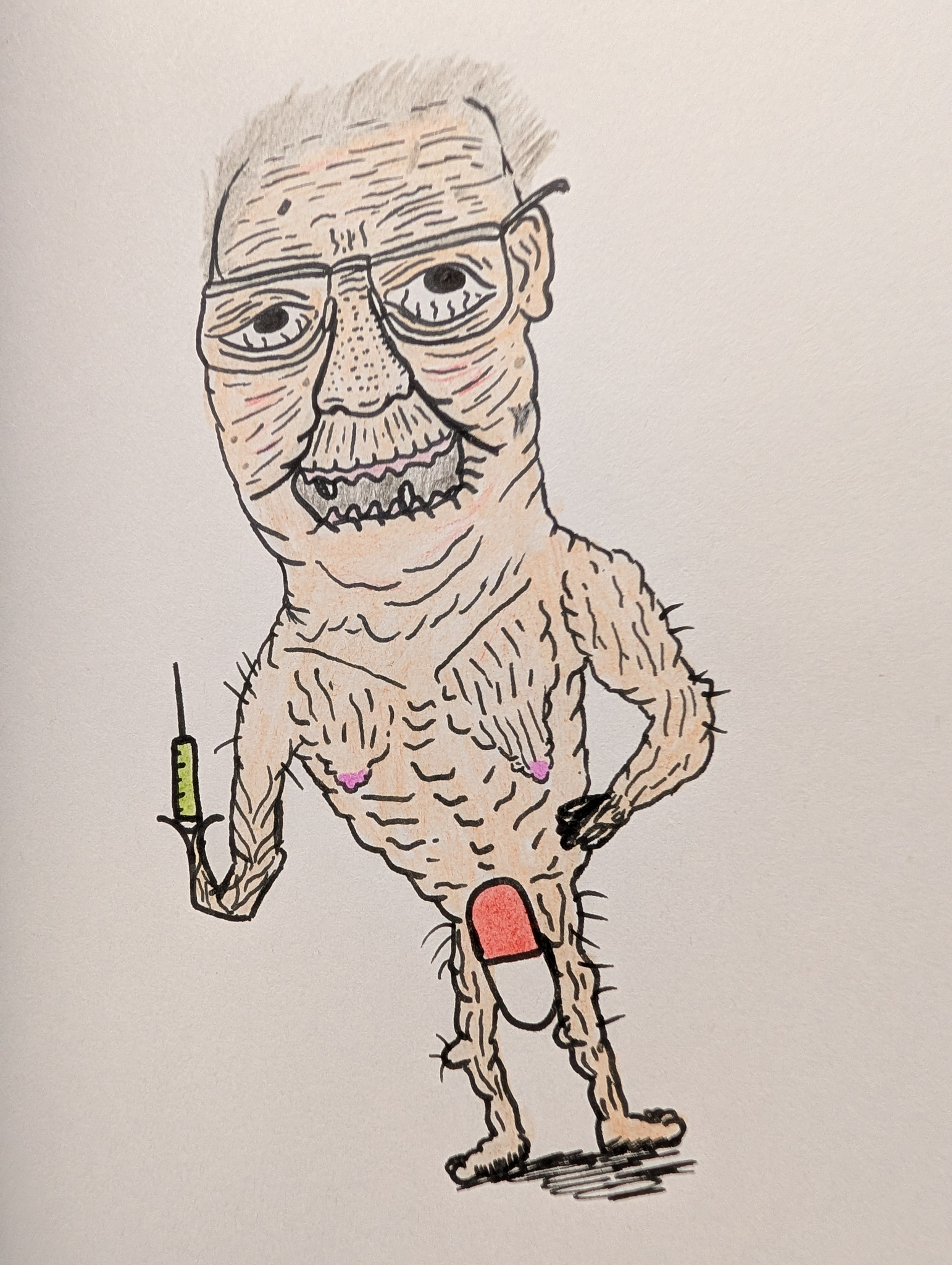
The personal thread. In the September 11 entry, the Driver (Joseph) recounts the family trip to Florida the week after the attacks. His uncle — a gay man forced to hide who he was his entire life — lived there. The uncle would die later that year of a drug overdose "sponsored by the Sackler Family."

That phrase — "sponsored by" — does all the work. It's the language of corporate patronage applied to death. The same syntax used for museum wings and charity galas. Sponsored by. Brought to you by. Made possible by a generous grant from. The Sacklers sponsored his uncle's death the same way they sponsored the Sackler Wing at the Met: with money made from the same product that killed him.

The uncle existed at the intersection of every system the Wireland critiques: closeted by a culture that would rather he didn't exist, medicated by a system that profited from his pain, and dead before anyone with power had any reason to care. He is not a statistic in the Wireland. He is a person the Driver loved who was killed by a family that put their name on buildings with the proceeds.

No Sackler has gone to prison. This is the fact around which the entire entry orbits.

The family extracted approximately $11 billion from Purdue Pharma before and during the bankruptcy proceedings. They then negotiated a settlement that dissolved Purdue, created a new company to continue selling opioids (the irony is not subtext — it is the text), and granted the Sackler family legal immunity from future civil lawsuits in exchange for a fraction of what they took.

The Bankruptcy Shield

Purdue filed for bankruptcy in 2019. The bankruptcy court became the mechanism through which the family shielded its personal wealth. The company died so the family could live. This is a corporate ritual — the entity is sacrificed to protect the bloodline.

The Settlement

The family agreed to pay $6 billion — roughly half of what they extracted. In exchange: immunity. The Supreme Court briefly disrupted this in 2024, but the deal was restructured and the immunity restored. The system corrected itself. It always does.

The Name Removal

Institutions began quietly removing the Sackler name from their walls. This is presented as accountability. It is actually the final phase of the laundering: the name served its purpose, the respectability was already absorbed, and now the removal creates the appearance of consequence where none exists. The money stays. The name comes off. The dead stay dead.

Over 500,000 Americans dead from opioid overdoses between 1999 and 2020. This number is conservative. It does not include the secondary deaths — the suicides of family members, the children who aged out of foster care, the people killed by addicts in crisis, the slow deaths of communities hollowed out by the economic collapse that follows when a generation is removed from the workforce.

The bloom was not accidental. The bloom was the product. The Sacklers did not create a painkiller that happened to be addictive. They created an addictive substance and marketed it as a painkiller. The distinction matters. One is negligence. The other is the architecture of a spell.

And like every spell in the Wireland, the enchantment outlives the enchanter. The Sacklers could disappear tomorrow — every dollar seized, every name sandblasted off every building — and the bloom would continue. Fentanyl is in every supply chain. The neural pathways are carved. The generational damage is structural. The flower does not need the gardener anymore. It has roots.

Within the Wireland framework, the Sacklers represent the purest expression of the poisonous flower's pharmaceutical petal. If September 11 was the political bloom — fear converted to surveillance, surveillance converted to control, control converted to profit — the opioid crisis is the somatic bloom. It operates on the body directly. No ideology required. No flag necessary. Just a nerve ending and a prescription pad.

The Godwynn parallel is structural. Nathaniel Godwynn extracts resources from the earth — minerals, artifacts, the Angel Orchid itself — and converts them into power through corporate infrastructure. The Sacklers extract resources from the human body — pain, dependency, death — and convert them into wealth through the same infrastructure. Both families operate behind the legal architecture of the corporation. Both families use philanthropy to launder the product of extraction. Both families are shielded from consequence by the systems they fund.

The difference is that Godwynn is fictional and the Sacklers are not. The Wireland's entire thesis about black magic capitalism — that the corporation is a spell, that the brand is an enchantment, that the product is a ritual object — finds its most literal expression in a pill that chemically rewires the brain to need more of itself. OxyContin is an enchantment you swallow. The body does the rest.

September 11, 2001

The Driver's uncle dies "sponsored by the Sackler Family" the same year as 9/11. Both events function as petals of the same poisonous flower — parallel blooms of black magic capitalism that feed on different vulnerabilities but share the same root system.

The Angel Orchid

The central artifact of the Wireland cosmology. The "poisonous flower" language used to describe the Sackler operation connects it directly to the Orchid's mythological function as a seed that blooms into total systems of control.

Nathaniel Godwynn

The fictional mirror. Godwynn extracts from the earth and launders through philanthropy. The Sacklers extract from the body and launder through philanthropy. Godwynn owns WTC steel as a trophy. The Sacklers owned museum wings as armor.

The Driver (Joseph)

The personal witness. The uncle's death is not presented as a statistic but as a theft — a life taken by a system that turned a closeted gay man's pain into a line item on a quarterly earnings report.

Black Magic Capitalism

The overarching framework. The Sacklers are its pharmaceutical expression: the spell cast through the medical system, the enchantment delivered by prescription, the ritual object sold over the counter.

The Cult of the Flower

In the post-apocalyptic timeline, the Cult forms around the Angel Orchid. The opioid crisis is the real-world preview — a population organized around a substance they cannot stop consuming, administered by a hierarchy that profits from their devotion.

Source Episodes: 3.5, Wireland Now, Kayfabe Nation • Series: Wireland Ranch, Wireland Now • Compiled from all available scripts in the Wireland canon.